
April 27, 1937–November 18, 2025

Always gracious, elegant, and kind, Mary Jo Watson loved Native art and wanted to share her passion with others. Through her teaching at the University of Oklahoma and out in communities, her curation, and her advocacy, she made lasting impacts in a region where support for Native artists has often been missing.
“Mary Jo was the reason I returned to Oklahoma for graduate school,” writes Amber Shaples, executive director of the Oklahoma Arts Council. “Her creation of the first PhD program in Native American art history fundamentally reshaped the academic and scholarly landscape, positioning Oklahoma as a central home for the study of Native American art.”
Sharples continues: “As my mentor, she guided my professional life, ultimately connecting me to the Oklahoma Arts Council. Long before my work with the agency, she herself served two terms on the Governor-appointed Council, shaping arts policy with the same insight she brought to her students.”
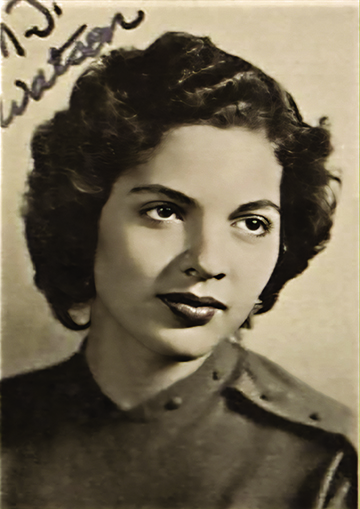
After marrying William C. Wantland (Seminole Nation) and raising three children, Mary Jo earned her bachelor’s degree in 1974, her MLS degree with a focus on Seminole aesthetics in 1979, and finally her interdisciplinary doctoral degree in Native American art history. She began teaching at OU as an adjunct in 1978 and taught her first class in Native American art history in 1980, without any models or textbooks to draw upon. She especially loved teaching about Mesoamerica.
In 1978, she helped found, along with my parents and many others, the Center of the American, a Native-led museum in Oklahoma City, and served as its first executive director. She curated changing exhibitions every month. Later she served as curator at the Fred Jones Jr. Museum of Art in Norman. She curated the first survey of Seminole art in Oklahoma and served on the Seminole Nation art council. She curated two exhibitions for the Oklahoma Arts Council that traveled nationally for years, and also Oklahoma Indian Art at the National Museum of History in Taiwan.
She was part of the curatorial team behind the long-term exhibition We Are Who We Were: American Indians in Oklahoma, representing the 38 federally recognized tribes in Oklahoma at the Oklahoma History Center. That community-led exhibition implemented a Native curatorial advisory committee in 2005, a generation before such curatorial models became more common. She also contributed numerous art-related entries to The Encyclopedia of Oklahoma History and Culture.
By 1993, Mary Jo taught full-time at OU. In time she became an associate dean of the College of Fine Arts and director of the OU School of Art and Art History in 2006. The University of Oklahoma awarded her numerous teaching awards. She always put her students first—she made them feel welcome, encouraged their interests, and praised them for their accomplishments. “She was an inspiration and tough as nails,” said her former student and teaching assistant Denise Neil (Delaware Tribe/Cherokee Nation).
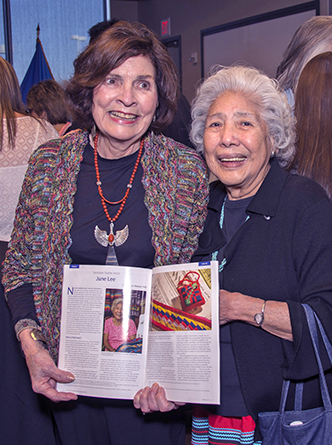
She encouraged her students to visit Native art centers and meet the artists they studied. She regularly invited artists, such as Richard Ray Whitman (Muscogee/Yuchi) and Ronald Anderson (Choctaw Nation/Chickasaw, 1938–2024). When I was a student, she arranged for Fritz Scholar (La Jolla Luiseño, 1937–2005) to demonstrate painting to our class.
First American Art Magazine exists because of Mary Jo. In her classes, she urged her students to write about Native art. She pointed out how little written material was available about Oklahoma Native artists, especially women artists, despite how talented and accomplished they were. She said she put “everything but the kitchen sink” in her dissertation, “Oklahoma Indian Women and Their Art,” because she felt it was the one time she could share information about these incredible women. Denise digitized the massive 474-page dissertation, and we uploaded it to Mary Jo’s academia.edu profile. For years after, I’d think I discovered a new Native woman artist, only to find out that Mary Jo had already written about her back in 1993.
She loved education because she loved learning. She loved books and amassed an impressive library. Many of her Native art books are now part of the Scholars Library at First Americans Museum, a museum she helped shape, with so many colleagues.
Mary Jo retired from teaching in 2018 but continued to serve on First Americans Museum’s collections and acquisitions committee and on First American Art Magazine’s editorial advisory board. Her daughter, Malia Bennett (Seminole Nation), cared for her after she moved to assisted living, where her friend Gene Brantly looked out for her. Amber Sharples and Scott Hale made sure she attended significant cultural events.
In her honor, former students created the Mvhayv scholarship fund to support the study of Native American art history at OU. More information can be found at give.oufoundation.org/WatsonMemorial.
All of our lives are better for having known Mary Jo.
—America Meredith (Cherokee Nation)
Selected Bibliography
Dissertation
- Mary Jo Watson, “Oklahoma Indian Women and Their Art” (PhD dissertation, University of Oklahoma, 1993), 474 pages | link
Journal Articles and Book Reviews
- Mark H. Palmer, R. Douglas Elmore, Mary Jo Watson, Kevin Kloesel, and Kristen Palmer, “Xoa:dau to Maunkaui: Integrating Indigenous Knowledge into an Undergraduate Earth Systems Science Course,” Journal of Geoscience Education, 57, no. 2 (January 31, 2018): 137–44 | link
- “Review of Art of the Cherokee: Prehistory to the Present, by Susan C. Power,” Great Plains Quarterly 28, no. 3 (Summer 2008): 244 | link
- “Review of Earth Songs, Moon Dreams: Paintings by American Indian Women by Patricia Janis Broder,” Great Plains Quarterly 21, no. 1 (Winter 2001): 83–84 | link
- “Review of Irene Avaalaaqiaq: Myth and Reality by Judith Nasby,” American Indian Culture and Research Journal 28, no. 4 (2004): 155–56 | link
Exhibition Catalogues
- “Guest Essay,” in Return from Exile: Contemporary Southeastern Indian Art, Tony A. Tiger, Bobby C. Martin, and Jace Weaver, eds. (Tahlequah, OK: Southeastern Indian Artists Association, 2015), 12–15.
- “Introduction,” in Hopituy: Hopi Art from the Permanent Collections, heather ahtone, ed. (Norman: University of Oklahoma Press, 2013), 13–15.
- Kiowa Artists and Oscar Brousse Jacobson (Norman, OK: Fred Jones Jr. Museum of Art, 1990).
- Teacher’s Manual: Making Medicine; The Art of Fort Marion (Oklahoma City: Center of the American Indian, 1985).
- “A Tradition of Appreciation: Native American Art at the University of Oklahoma,” in The James T. Bialac Native American Art Collections, Mary Andrew White (Norman: University of Oklahoma Press, 2012), 3–6.
- Mary Jo Watson and heather ahtone, Art from Indian Territory 2007: The State of Being American Indian (Oklahoma City: American Indian Cultural Center & Museum, 2007).
- Mary Jo Watson and John Elder, Doc Tate Nevaquaya: In the Realm of Thirteen Feathers (Oklahoma City: Red Earth Museum, 2000).
Magazines Articles
- “June Lee: Seminole Textile Artist,” First American Art Magazine no. 10 (Spring 2016), 66–71 | link | FAAM Link
- “Tony Tiger: Muscogee-Seminole-Sac & Fox Mixed-Media Artist,” First American Art Magazine no. 16 (Fall 2017), 60–65 | FAAM link
- “Wendy Red Star: Crow Interdisciplinary Artist,” First American Art Magazine, no. 5 (Winter 2014/15), 34–39 | link | FAAM link
Encyclopedia Entries
- Mary Jo Watson, “Art, American Indian,” The Encyclopedia of Oklahoma History and Culture, Oklahoma Historical Society, January 15, 2010 | link
- “Asah, Spencer (ca. 1905–1954),” The Encyclopedia of Oklahoma History and Culture, Oklahoma Historical Society, January 15, 2010 | link
- “Auchiah, James (1906–1974),” The Encyclopedia of Oklahoma History and Culture, Oklahoma Historical Society, January 15, 2010 | link
- “Cannon, Tommy Wayne (1946–1978),” The Encyclopedia of Oklahoma History and Culture, Oklahoma Historical Society, January 15, 2010 | link
- “Hokeah, Jack (ca. 1902–1969),” The Encyclopedia of Oklahoma History and Culture, Oklahoma Historical Society, January 15, 2010 | link
- “Jacobson, Oscar Brousse (1882–1966),” The Encyclopedia of Oklahoma History and Culture, Oklahoma Historical Society, January 15, 2010 | link“Mopope, Stephen (1898–1974),” The Encyclopedia of Oklahoma History and Culture, Oklahoma Historical Society, January 15, 2010 | link
- “Smoky, Lois (1907–1981),” The Encyclopedia of Oklahoma History and Culture, Oklahoma Historical Society, January 15, 2010 | link
- “Tsatoke, Monroe (1904–1937),” The Encyclopedia of Oklahoma History and Culture, Oklahoma Historical Society, January 15, 2010 | link
Links
- Mary Jo Watson, academia.edu
- University of Oklahoma, School of Visual Arts
- Hall of Fame Biography, Oklahoma Higher Education Heritage Society
- Obituary, by Malia Bennett (Seminole Nation), Amber Sharples, and Scott W. Hale
- Mvhayv Award Fund, University of Oklahoma Foundation