
By Tahnee Ahtone (Kiowa/Mvskoki/Seminole)
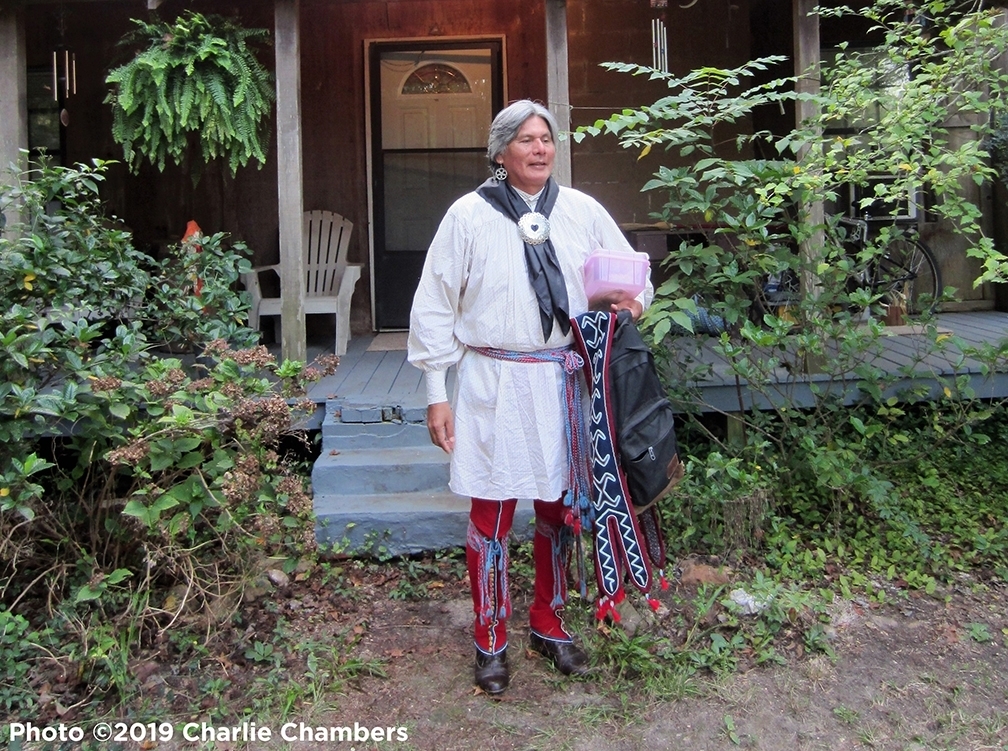
I write to honor the life of Eco-Mahe Damian Jay McGirt (March 23, 1953–December 18, 2018), the respected historian of Maskoke and other Southeastern Indigenous cultures, who has gone to his campfire in the sky. It is with great sadness and heavy hearts that we announce the sudden passing of Uncle Jay in Tulsa, Oklahoma. Born in Okemah in 1953, Jay grew up in Okfuskee, a Maskoke community in rural Okfuskee County. He was from the Wind Clan and Tokvpvcce Etvlwv and a son of the Deer Clan.
As a teenager, inspired by Plains Indigenous peoples’ continuity in the making of their own regalia, Jay was determined to seek a resurgence of creating Southeastern Indigenous clothing. A master beadwork artist, and with more than 40 years of experience as a textile artist, Jay successfully revived the production of beaded Maskoke bandolier bags, and he promoted the sewing and daily wearing of Southeastern tribal clothing.
One of Jay’s greatest honors was his acceptance into and completion of a competitive internship program at the Smithsonian Institution, under the supervision of William C. Sturtevant, for the study of historic Southeastern textiles and beadwork.
Jay’s beadwork creations were all finely detailed with size 13° cut charlotte beads, fine silk threads, and top-quality Morton and Stroud wools from his personal collections and honoring gifts. Jay’s bandolier bags can be seen in the collections of the Philbrook Museum of Art, the Smithsonian Institution, National Cowboy and Western Heritage Museum, Oklahoma History Center, Seminole Nation Museum, Museum of the Red River, Kerretv Cuko Museum (Poarch Creek tribal museum), Baltimore Clayworks, Eiteljorg Museum of American Indians and Western Art, Birmingham Museum of Art, and the Ah-Tah-Thi-Ki Museum, where one of his most prized pieces, which was contributed to the museum’s collection, is on permanent display.
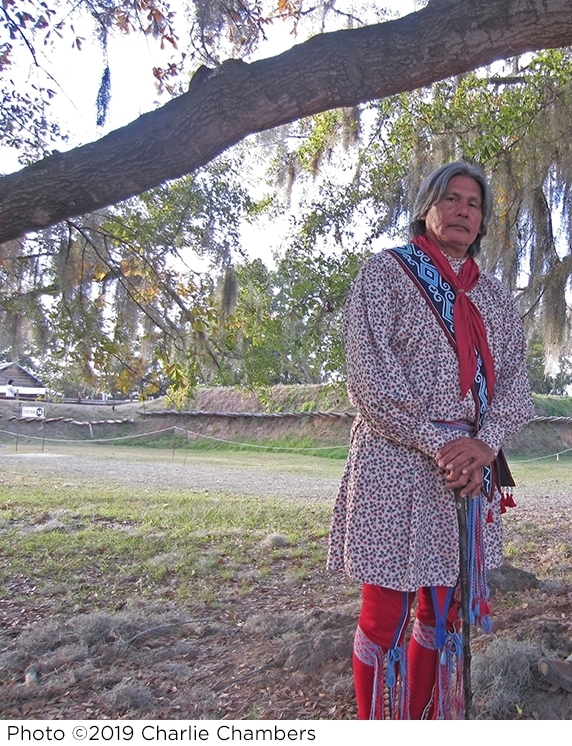
An avid believer in Indigenous resistance and maintaining independence from tribal governments, Jay was involved in the White Roots of Peace movement and other activism for the rights of Indigenous peoples. He was a fluent Maskoke speaker and taught at the Pemayetv Emahakv Charter School’s Creek Language Immersion Program on the Brighton Seminole Reservation in Florida. Jay shared his knowledge with the world as a teacher, artisan, and historian to the US National Park Service’s Ocmulgee National Monument, Fort Toulouse, and the Moundville Archaeological Park and its Jones Archaeological Museum, where he supervised the production of time period regalia in the living history scenes. He also served as a consultant on the play, Tecumseh at Tokvpvcce, which dramatizes the Shawnee leaders sparking the Red Stick movement among the Maskoke people.
Jay’s skills and knowledge in the Maskoke culture will always be unquestioned. He taught us our language, humility in song and dance, and many methods of finger weaving, appliqué, beadwork, and baldric iconography.
Jay would often say, “Ekerrvhaneckatvlkes; este-cate em ponvkv eteroptten, estimvt oweckat kerreckvres. Este-hvtket oweckekot onkv este-hvtke em accvke vccetvt okotos. Nettv-vtekat este-catet em accvke vccetvt os.” (“You have to know yourself; It is through the Maskoke language that you will know who you are. You’re not a white person, so you’re not supposed to wear white people’s clothes; You’re supposed to wear Indian clothes, every day.”)
Uncle Jay sometimes mentioned that he hoped his life would leave a legacy of cultural revival, and so we say to you, dear uncle: “Mvtat mececkvtet os” (You did just that).
We thank you for all you have gifted us in this world.
Tahnee M. Ahtone is an American scholar and museum professional with dual degrees in humanities and fine arts. Her research focus includes 20th- and 21st-century costume and textile designs, Indigenous peoples, diversity, and inclusion | link
6 Comments
Jay Mcgirt was all the above and more. Learn so much from him. Jay had a way of of communicating that when he spoke of past events it same as if you and he was living it again. He also has role in stories from Georgia about Chief Macintosh and the force removal of indians to Oklahoma.Very knowledgeable about current events. Just seem he left too early.
See you Jay, cousin James McGirt
Thank you so much for sharing!
“When you were born, you cried and the world rejoiced. Live your life so that when you die, the world cries and you rejoice.” – (Native American Quote)
I was introduced to Jay years ago by his blood brother who happens to be my brother in law. Jay was attending a fair in Georgia at the time. I hold very fond memories of that afternoon. l was greatly saddened by his early passing.
Thank you for sharing!
Just curious as to who told you he was Jays blood brother. His sister is my mother-in-law
Jay and I spent about 3 hours sitting atop Mound A at Moundville, AL from about midnight til about 3AM talking about every subject under the full moon. I will carry the memory of that morning with me forever.