
Interview, transcription, and editing by Thollem

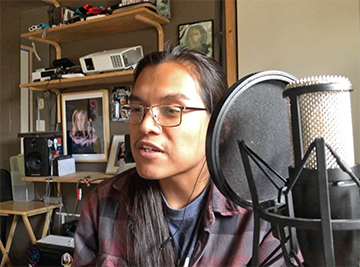
Only a Dream is the latest album by acbo, an experimental electronic music project by Dylan Tenorio (Kewa/Diné) of Santa Fe. His album review appears in FAAM No. 47, Summer 2025, but he had a lot to share, so here is more of his interview.
Hello, my name is Dylan Tenorio. I make music under the name acbo, and I’ve been using that name since 2011. I make a lot of electronic music in various genres, including jungle and drum and bass, glitch hop, other forms of hip hop, and just general electronic music. Jungle and drum and bass were pretty rare to hear on the rez, and the only place I could hear it was playing video games. So, when I heard that music in Kewa, I was paired with the ancient, beautiful aspects of my own cultural music and the new styles embedded within the video games I played when I was a kid.
This album is built on this sense that we’re in a dream at the moment. When I was four, I had a near-death experience that left me feeling afterward like I was in a dream.
In the song “Setting Moon,” Edie Tsong talks about bringing up a childhood memory, and the entire time she’s also trying to call somebody. It turns out that who she’s trying to call is a call center for selling dream states and simulations, sort of Total Recall. That way, people can have experiences that aren’t real. This song is like what happens in The Matrix. This album plays on those themes, like waking up from simulations. The last song, “Only a Dream,” share this aesthetic.
Hearing the two genres in the background of my own culture [made me feel]like I was attached to both the future and the past. I am considering the future that we still have, but there’s also this sense that we’re losing it at the same time. This album portrays what it feels like for somebody who’s gone through all those different things and have found themselves in a place where everything feels like a dream. Everything doesn’t feel so real after a while.
>I don’t need to combine my traditional music with electronic music, but I do feel that my experience as a Native person, as an Indigenous person is still reflected within the music itself. I want my music to show that Indigenous people are still reflecting on this world and living within it. We are still here, still creating with what’s available to us.
Addressing the Times

We’ve yet to see what our sense of modernity is in this moment, and perhaps that making music in new ways that no one has ever put together might be a way for us to access different minds—to be able to understand what our experience is. The more and more we do this, the more we can tell and share our stories in various ways, but not in a form that is exploitative, but it is completely expressive. I’ve always loved drum and bass, electronic music in general, because you can be free in those types of productions and those types of audio engineering projects. It takes a long time to learn the techniques, but as soon as you have, you can express different complex emotions that you might not have otherwise through [established]music.
I’ve always loved that capability to express anything through electronic music—to have a wide range of audiences be able to understand it, especially for those people who will both play games and listen to music on a regular basis. There’s a lot contextually to use to explore, and I’ve loved doing that. I see it as a healing process for all of us. I don’t try to present any answers through my music, but I do love to be able to reflect upon what I’m feeling and what maybe many other people in the country are feeling.
One game that I relate to a lot in this album is Majora’s Mask, which is a part of the Legend of Zelda series. This game is one of the darkest of the whole series, and it’s in this space between grief and happiness. Different stories within that game talk about losing things—losing people, culture, even reality—and trying to find your path back to friends, back to home, and back to belonging.
Singers and Guides
The last song on the album, “Only a Dream,” features Nadine [Nizhoni (Diné)]. She leaves us feeling this sense that we—as Americans, we as Indigenous people, we as just human beings in general—need to wake up and that we need to move. We need to actually start doing things to be able to either save ourselves from what is happening right now or to just straight-up reinvent this place that we called home. Her voice leaves us in that space. It’s not meant to have any answers toward what we should be doing, but that first step is waking up. This album represents that. It’s a call to action and a call to prayer, to be able to start moving in that direction where we are getting closer and closer to something that we can call home.

This album has that notion of healing through all these motives of waking up. It’s interesting, I always felt that SX Q’s voice represented the voice of the regular American people who are being oppressed by this system, be it within the mass incarceration system or through wealth and income inequality or through environmental crisis. It’s just this voice that always has been throughout this reality, just talking about what we need to be doing. We need to be embracing who we are; we need to be bracing for this moment. And she’s also representing in a way what we feel on a normal basis when we’re drenched in all these different forms of trauma, be it seeing what our country is doing across the seas or understanding that we’re not really being taken care of by a system that we were supposed to be influencing the entire time. So SXQ, [singer Sienna Prillaman], she’s always represented that voice.
In “Only a Dream,” Nadine’s voice represents what I think is Gen Z. This world is what they’re going to inherit next. And the responsibility of saving this world, saving this society, is a heavy weight that I think makes people feel isolated. And I want this album, especially this last song, to be a way for them to know that they’re not alone. There are people who have seen this happen over and over and over again, and they can still fight against it. This last song encapsulates that feeling that we should all be paying attention. You’ll notice in that it seems like the person who is the subject of this song is struggling to wake up. It should feel like this person is constantly waking up, reprising to the point where they’re about to open their eyes, but then suddenly they lose grasp and they fall back into sleep, into deep, deep sleep only to be tugged at again by her voice and be pulled by this muse who’s trying to get us to do something, do something that might change things for the better, and to bring a sense of home and a sense of belonging.
In the last song, when Nadine comes on, it’s fresh, it’s new, it’s a different singer. It feels like a little out of body, and in a way, represents the true essence of what people from this land feel and are trying to express. When she comes on, it feels like the voice of Essex Q has spent her energy to relay that to us as an audience. Then in “Only a Dream,” Nadine is outside of that, and she’s a muse. She’s calling forth the energy to return back. Even though we’ve been fighting this fight for so long and we’ve wanted change, so many different people have died, and so many people have grown tired of having to fight for these causes.
There’s still this spirit of who we are and what we come from as human beings invoking us to really step up. Nadine’s voice represents that. This album represents what it feels like to be in a liminal space, to be in a moment of transition, relating to what’s happening right now in our country and perhaps even the world. We’re constantly in a moment of transition.
Pushing Forward
Ever since I’ve grown up, it feels like this country has been trying to be born into something far better than we had hoped for, only to fall back into a place where it was either subpar or the change never actually happened. So we’ve always felt like it was stalled, and we have never felt like we arrived at our destination.
These genres involve a lot of production. So, watching my grandparents, my grandma Maisie, and my grandpa Eski Rio, they would be together working on different pieces of jewelry as a team. So I would see my grandma making up the concepts and stringing the actual beads together that were just cut chunks of turquoise or black jet or coral. My grandpa cut those stones into square pieces. My grandma then strung them together to create the patterns, and then he rounded them out and polished them. Then my grandma added all the silver [findings]to be able to put it around your neck. I witnessed the whole process. Making music on any sort of DAW (digital audio workstation) felt like I was making a piece of jewelry, a necklace. Instead of beads, I was making it with beats.
My name acbo is a play on the idea that imagination [allows]you to consider what you’re going through or what the future might hold for you. We usually think in an A, B, C format where we go from point A to point B to point C, but ACB is a symbol and represents using that way of thinking and flipping on itself to where instead of you go from A, B, C, you think of A, C, B. You’re using dreams and imaginations to consider what the future might hold before you make that decision. When you go from A to C and then to B, you’re at least informed by what you possibly might do and those consequences, what you do actually might have a better outcome if you can consider what your imagination actually is telling you.
My hope is that the young Gen Z Indigenous listeners, maybe even the Gen Alpha listeners, can take this album in and know that they are not alone. This album is a prayer. It’s a way to reflect upon what is happening through beats, through drum and bass, and through movements of synthesizers, bass, and other sounds. Altogether, I hope, this creates an alchemy to inspire them to start considering, Well, what could that solution be? What does collaboration mean in a future where it seems so dire? How can they create something that can actually help the world and can help their own community?
Links
- acbo on Bandcamp
- Only a Dream, Bandcamp
- Dylan Tenorio, LinkedIn
- Artists Engaged, by artists about artists in action, video series produced by Thollem and ACVilla
This interview has been edited for brevity and clarity.