
MUSKOGEE, Okla. – Since 1935, some of the most well-known American Indian artists have passed through the art department at Bacone College, but recent years, financial difficulties resulted in the college almost suspending operations. The art department was subject to the ups and downs of the college, and it, too, was almost lost. However, Dr. Ferlin Clark (Navajo), who arrived from New Mexico to take over as president of Bacone in May 2018, recently announced the reestablishment of Bacone’s historic art program as a major component of the college’s recovery. With the support of Mvskoke filmmaker Sterlin Harjo, Clark hopes to eventually add a film school to the program’s offerings.
But to begin, Bacone will offer students in the upcoming spring semester an introductory art course that features week-long residencies with Native artists including, so far, Harjo, painters Tim Nevaquaya (Comanche) and Gerald Cournoyer (Oglala Lakota), who will be the professor of record for the course. Clark said he has been in touch with several other artists who have expressed interest as well.
Bacone was opened in 1881 in Tahlequah, Cherokee Nation, Indian Territory, then moved in 1885 to land donated by the Muscogee (Creek) Nation in Muskogee. While non-Native students did and do attend Bacone, its original focus was the education of American Indian students. In 1932, Bacone College opened the Ataloa Art Lodge on campus to expose students to Indigenous art from diverse tribal nations across the United States. Soon after, the college established an art department led by painter Acee Blue Eagle (Muscogee-Pawnee-Wichita). The Flatstyle painting he promoted was influenced by Art Deco and other Modernist movements and is sometimes known as Bacone School. Along with an emphasis on draftsmanship and precision, Flatstyle painting was characterized by light backgrounds and solid colors, most often painted in opaque watercolor. Many WPA murals by Indian artists were painted in this style and can still be seen across Oklahoma today. Blue Eagle was followed by Woody Crumbo (Potawatomi), Richard “Dick” West (Southern Cheyenne), Ruthe Blalock Jones (Delaware/Shawnee/Peoria), and Tony Tiger (Muscogee/Seminole/Sac & Fox).
Clark is realistic about the enormous challenges Bacone must overcome, from financial deficits to needed repairs for the historic buildings. But Clark said raising morale among faculty, staff, and students – both current and potential – may be the most important part of the college’s recovery.
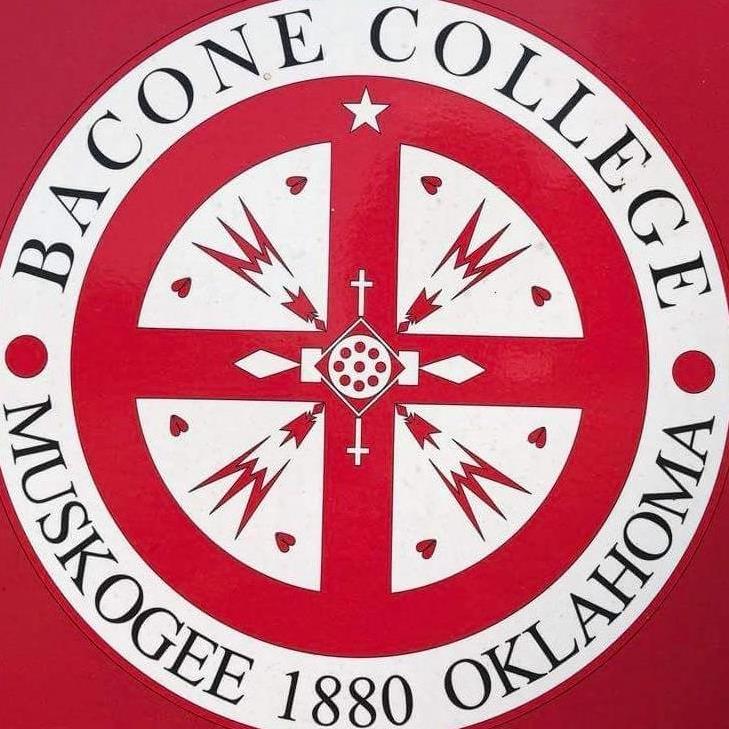
“As we’re rebuilding Bacone College, rather than just rebuild it, we needed to put the spirit back into our campaign,” Clark said. “This campaign is built around the medicine wheel [that is Bacone’s logo]. Even the medicine wheel [was created]by Ruthe Blalock Jones and a former version was by Dick West. This campaign is bringing that back, resolving that mission, which is to educate Indian students. But it’s a new century. It’s a new era. As Native people, we have assumed leadership positions. Culturally, I feel like art really represents the expression of our rich culture, our history, our philosophy, our stories, our songs, and our ceremony. In some eyes, it’s seen as being unnecessary, unimportant, trivial. But for us, you know, for me, I come from a place where I had no running water, no electricity. So, being real basic and grounded in that regard, and seeing all these beautiful drawings and paintings, and then coming upon the building where the art program used to be. … It brings some sadness because a lot of these programs were just dismantled or disregarded. And so, the art program became something exciting.”
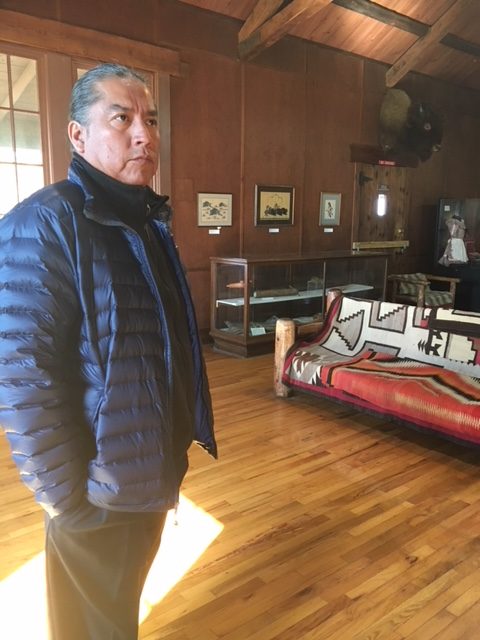
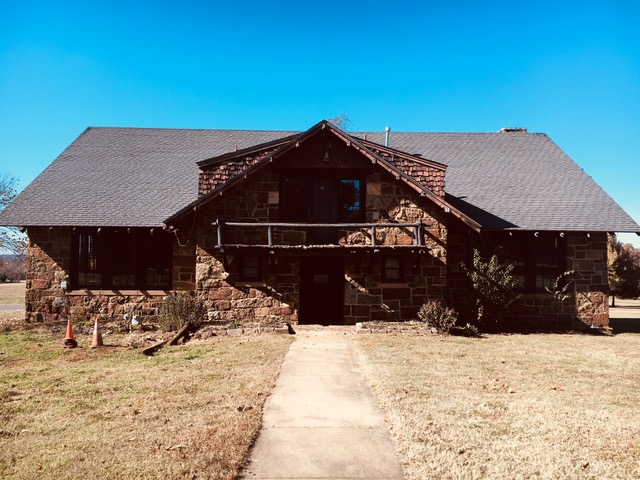
Clark is still learning the history of Bacone College and its art program. As he walked among the displays of art in the formerly shuttered Ataloa Art Lodge, the studios where art equipment stood as if the artists had just stepped out, and the cluttered theater where plays and musical events used to be held, Clark pointed out the various objects of which Bacone is the steward. He lamented how the college’s many years of problems affected not only the student-artists and the professors but the artwork itself, some of which has not been stored properly over the years. But he has faith that refocusing on the art program can be a healing process for all.
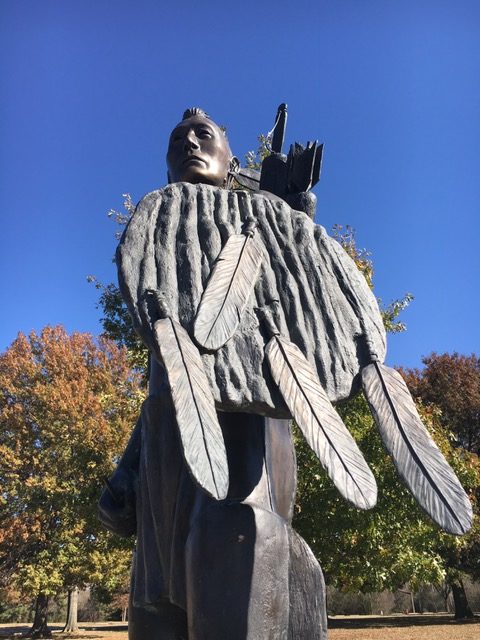
“My path here, what I’m trying to do, is trying not to have people close us down,” he said. “I’m trying to fight, being the warrior, you know, and we’re the Bacone College Warriors, too. They already have all these things, you know? They were just left alone. They had this medicine wheel [logo]. It was already here. It represents our universal Native American philosophy, framework … the four directions, the four seasons, the four elements, natural elements. And then you have the warrior piece of it, the shield. He has a shield, but he also has an arrow. That’s our language, culture, history, philosophy. That’s what art is. The arrow is like a pen, for writing, that kind of representation.”
Clark said the revitalized art program will focus on diverse media, from ancient techniques of basketry and weaving to painting to the most current methods of filmmaking. Clark is excited to see how film will be incorporated into the history of Bacone’s art program, especially with the addition of Harjo.
“Bacone College is pivoting…,” said Clark. “In order for us to go forward, we have to go back. It’s part of history … the storytelling, the oral history piece of it. That’s what excited me. [Sterlin Harjo] is using visuals. Us Indian people, we tell stories. He’s telling stories. He’s making people laugh. He’s making people cry. And he’s connected to the millennials far more than a lot of us. So, as we move forward, we [realized we were]missing a segment of our Native American community within the state of Oklahoma. The young folks. He’s bringing that. He’s like that thunderbolt that’s coming in.”
Bringing Bacone College back to a healthy state will require time, energy, money, and faith. Clark believes that investing in the art program is a way to return the college’s focus to its American Indian heritage. He points again to the Medicine Wheel on the Bacone College seal.
“It is refocusing us back on our Indian mission in, not disregarding our current academic programs, but adding [a focus on the art program]as our effort to demonstrate that we want to not just survive but to thrive,” said Clark. “Every day there’s a child being born, so I think these students graduating from high school can have a place they can stay, a place that they can study, from some very dynamic, prolific artists, young and old, and from different genres or disciplines. And Bacone will also be a place for our leaders – cultural, spiritual, political, community leaders, male and female – to come to share their experiences, their thoughts, their vision. That, to me, is exciting, as we also do the heavy lifting of securing funds, maintaining our accreditation, all the things that keep the college operating.
Clark said museums, galleries, tribes, artists, and community members have come forward since news of the upcoming art program has filtered out. He said it gives him strength for the intricate, daunting job of rebuilding the college and the art program.
“We have faith. We have hope. And we’re hoping for some charity,” he said. “We definitely had a lot of love out there for Bacone. And it’s nostalgic. It’s sentimental. It’s emotional. Bacone is just a very special place. And I’m here to restoke that fire that’s at the center of this medicine wheel, rekindle it, bring some life to it, have it grow again. And out of those ashes, we’re gonna rise like the Phoenix and spread our wings and ride that crystal wind to carry us into the future. That’s my hope.”
2 Comments
will you be producing an art magazine at Bacone? I would love a subscription if so.
Hi Kay, you can find the Bacone School of Art’s contact info on their website here :: https://www.bacone.edu/school-of-art/. Our upcoming issue of First American Art Magazine, No. 30 (Spring 2021) will include a feature article about Michael Elizondo Jr. and Bacone’s plans for its art program!