
Fans of the long-running US television show Grey’s Anatomy are used to seeing work from Indigenous artists from the Pacific Northwest Coast. The show, a medical drama, is set in a hospital in Seattle, and prints of Indigenous art can often be seen on the walls of the hospital sets. On May 10, 2021, a storyline involving Suquamish characters who had a baby at the hospital showcased, up close, a red cradleboard. The episode, #15 of Season 17, is called “Tradition.”
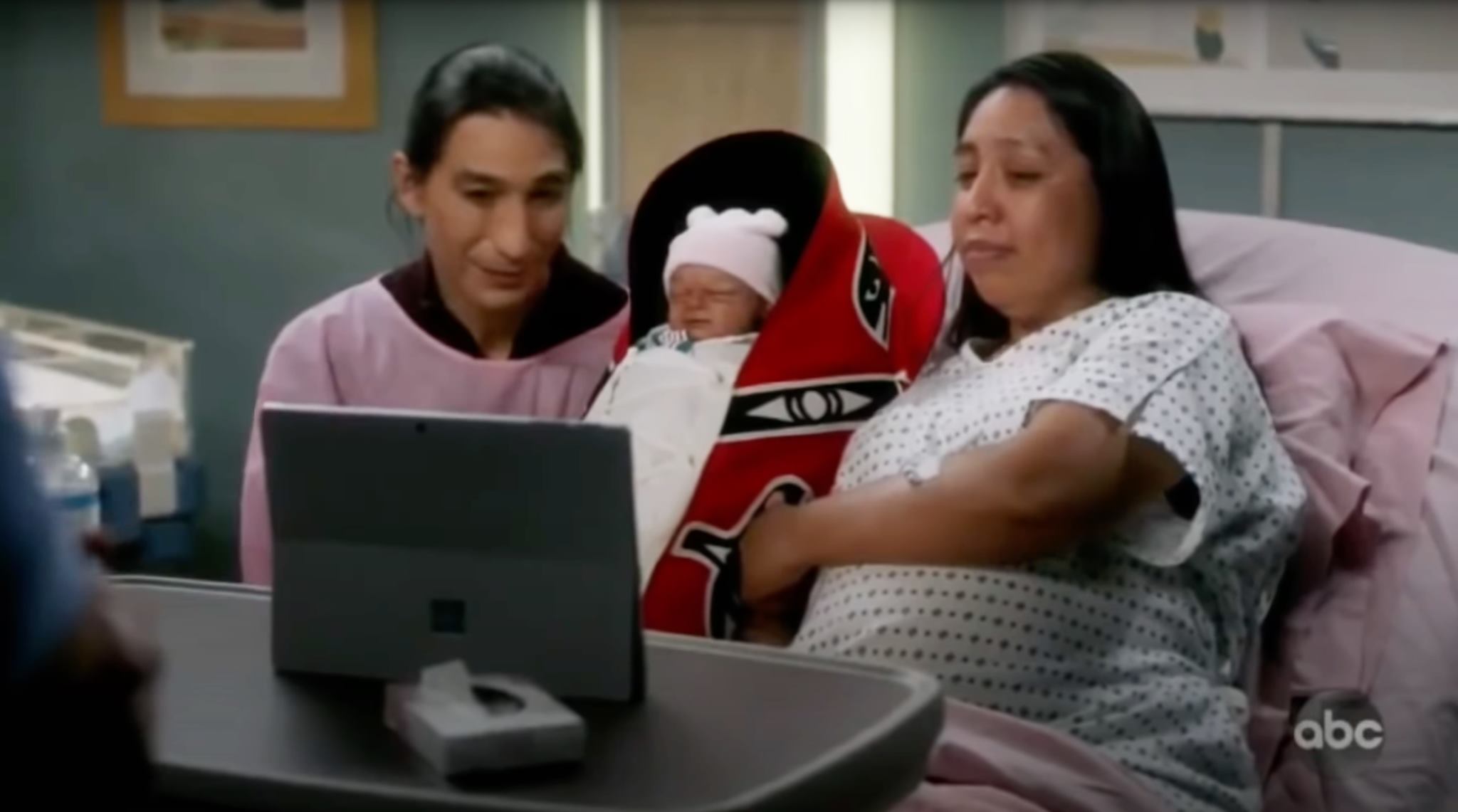
The creator of the cradleboard, Taylor Henry, is a citizen of the Tulalip Tribes of Washington. His aunt and cousins are master weavers, and he has woven with cedar bark for as long as he can remember and with wool for a few years. He is a beadwork artist, who also sews, makes regalia, and, of course, cradleboards. He leads craft workshops for the Hibulb Cultural Center’s Rediscovery Project, which he did remotely during the pandemic when he also began to focus on loom weaving.
“Last year during COVID, we couldn’t go anywhere,” Henry says. “I was staying home in front of my loom basically twelve hours a day, so my weaving took off from there. Lately, I’ve been doing cedar weaving, wool weaving, beadwork, and sewing.”
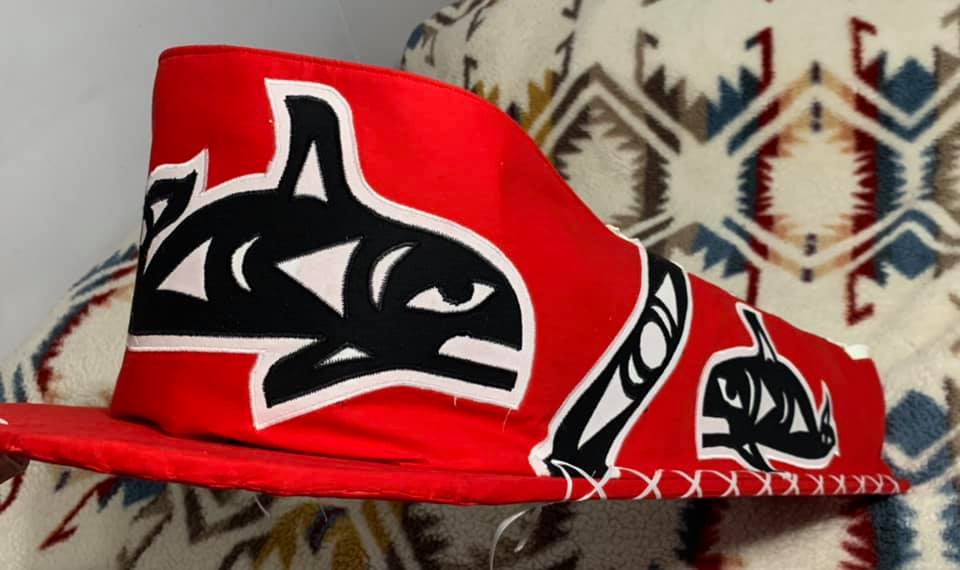
While the Grey’s Anatomy cradleboard was made specifically for the show, Henry took the care he would for a cradleboard that was going to a baby. The board is made of red cedar, and he used red, white, and black, all of which are significant colors for Coast Salish people.
“Red, for Coast Salish people, is a very, very powerful color,” says Henry. “A lot of the things we use in our ceremonies, the powders and the paints that we use, come from a red powder, a red base, red dirt, red cedar bark from a cedar stump, so I decided to go with the red material for the base color.”
The back and top of the cradleboard cannot be seen on the show, but Henry posted a photo of them on his social media.
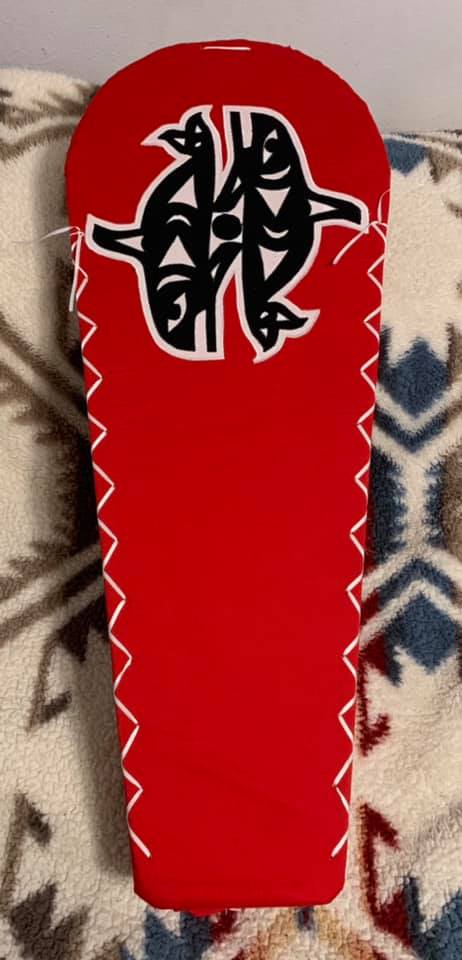
“The back of it is two whales in a spindle whorl design,” he explained. “I chose that because right now, I am primarily a weaver, and I feel very strongly about it right now. The spindle whorl depicts a transformation. I felt it was only proper or right that I did a spindle whorl design because the mother carries the child. She makes the child for nine months, and then it comes out of her into a beautiful little baby, so, she’s transforming something. There is another killer whale on the top. The killer whale, or the blackfish, is the highest animal in our legends. The Tulalip Tribes are killer whale people, so, I felt it was only right to represent killer whale people.”
The stripes on the side of the board as well as the background color of the designs are also meaningful.
“The stripes have a circle, a crescent, and a trigon in a little band,” he says. “Those are the three elements in Coast Salish art that we use, and the white background of the designs represents the purity of a newborn. They are so sensitive to everything around them. In Native country, the children are the ones that usually can receive messages from our ancestors or can hear songs. I want to say they are knowledge keepers, and they don’t know that they are.”
Henry says it was an honor to be asked to share Tulalip designs on a mainstream television show.
“I’m just a tribal member that grew up on the rez, and you don’t hear very often of tribal people,” he says, emotion in his voice. “There are a few, but not from here. Not from Tulalip. So seeing it on TV felt like that cradleboard wasn’t just mine. These things of our ancestors, you know, we wouldn’t have them without the people that were here before us. So, it felt like me and my Coast Salish people were being acknowledged. It’s not just me being noticed. It’s the Coast Salish people and the people that came before us, our ancestors. It’s a very humbling, humbling experience.”
The cradleboard was purchased by Grey’s Anatomy and will be part of the show’s archives.
You can find more of Henry’s work on @Tayhenry09 on Instagram.
1 Comment
This is the most beautiful cradle board I have ever seen. So proud of our Pacific Northwest Brothers and Sisters. From another Pacific Coast Tribe- lThe Chumash Nation.