
By Joel Southall (Chippewas of Rama First Nation)
The scent of sage and frybread lingers in the light-filled atmosphere of Eugene’s Farmers Market Pavilion, where sunlight filters through tall glass walls and open roll-up doors onto tables of beadwork, paintings, and cornhusk dolls. Amid discreet speakers, the gentle notes of Indigenous flute music drift through the room, mingling with laughter that echoes softly against the pavilion’s timber beams. For board member and volunteer coordinator Doug Ford, who also teaches welding at Lane Community College (LCC), the Native American Arts and Crafts Makers Market is less a marketplace than a homecoming. “Selling the merchandise is secondary,” he says. “It’s about being together—from little kids running around to Elders sharing their wisdom.” Within this contemporary wood-and-glass gathering space, artists and families renew old connections and sustain a living practice through making and being together.
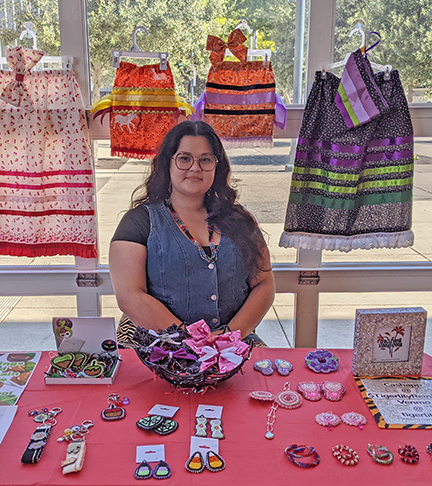
Activist and jeweler Marcy Middleton (Diné) cofounded the market with activist, graphic artist, and poet Rowena Jackson (Klamath) in 2013, beginning as a small winter event at Eugene’s Amazon Community Center. “We were at a potluck at the LCC Longhouse,” she recalls, “and said, wouldn’t it be nice to have our own Native market?” That first gathering, with about 14 vendors, grew steadily each year.
Today, the market runs for nine months at the Farmers Market Pavilion, still closing each year with the annual Winter Market at the Amazon Community Center. Over time, it has become a nonprofit organization with a board of directors, welcoming Indigenous artists from across the Americas.
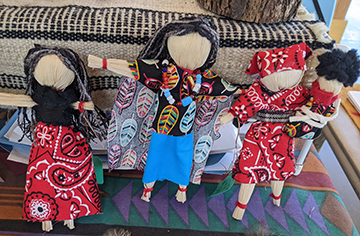
Among the artists, each table tells a story of care and connection. Aleta Miller, who identifies as having Cherokee and Choctaw heritage, is a longtime vendor who once helped organize the market. She fills her table with cornhusk dolls—each one finely detailed, painted, and braided with small offerings of plant fiber and bead. Originally from Sacramento and part of the Eugene community since 1977, Miller is a master maker of cornhusk dolls.
Miller’s dolls intentionally bear no faces, honoring the teachings of the Haudenosaunee story, “The Doll with No Face,” a reminder of humility and the responsibilities that come with beauty and skill. She harvests many of the husks herself, describing corn as “the mother of all of us Native people,” and speaks of her dolls as carrying distinct spirits.
Nearby, Tigerlily Reinhard (Grand Ronde/Klamath) displays bright ribbon skirts and braided jewelry, their colors drawn from nature. “Doing this is my medicine,” she says, explaining that the work reconnects her to community and ancestors. Together, her work transforms the pavilion into something more than a marketplace—a living circle where creativity becomes celebration and heritage continues through the hands of each new generation.
For Marcy, creating that sense of comfort and continuity is the heart of the market. “We’ve encouraged artists of different ages to bring their arts or crafts to sell,” she says. “Some have never vended before. We help them with pricing, customer service, and labeling. It’s encouraging when they feel comfortable and supported in our market space.” That mentorship, she adds, has led to something lasting: vendors helping one another and building support networks beyond the event itself.
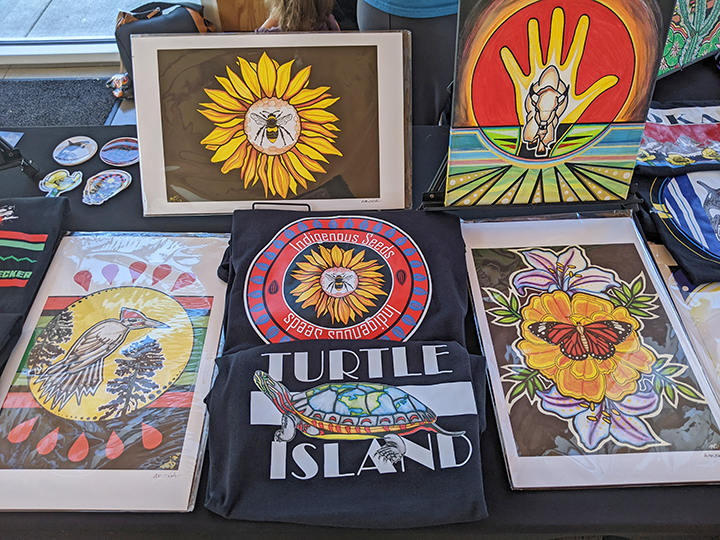
At another booth, painter and mixed-media artist Arusha Dittmer (Ho-Chunk) blends the fluid appliqué designs of Ho-Chunk ribbonwork with Woodlands School painting and influences of the Pacific Northwest ecology, creating vivid works in watercolor, acrylic, and ink. Her pieces pulse with color in spirals, roots, and animal forms that recall the coastal forests where she grew up. She speaks of her work as both personal expression and environmental reminder. “My art is about going back to the land and eating like our ancestors,” she explains. “It’s ceremony, a way to stay connected.” For Arusha, as for many others here, history is not fixed but evolving, shaped by lived experience and the land. The diversity within the pavilion—woven rugs, beadwork, cornhusk dolls, and painted panels—speaks to the intertribal networks that sustain Indigenous art across generations and geographies.
Part of what keeps the market accessible, Marcy explains, is a sliding-scale vendor fee, $30 to $60, that allows newcomers to participate without financial strain. “Some vendors even choose to pay more,” she says, “because they believe in supporting the community.” On any given market day, 15 to 20 artists fill the pavilion with their work, and the success Marcy values most is simple: “That our artists and crafters keep coming back and make the effort to be at our first-Sunday event.”
The market is sometimes mistaken by outside observers for a craft fair, but for those who gather here, it is something deeper: a space of kinship, teaching, and shared care that continues to grow each season.
As the day winds down, late-afternoon light pours through the pavilion’s glass walls, catching the shimmer of beadwork and the folds of bright fabric. Children help their parents pack boxes while Elders linger in conversation, reluctant to let the day end. “Seeing families, grandparents, babies, friends, and vendors talking and helping each other,” Marcy says, “that’s what makes it all worth it.” What remains is more than what was bought or sold; it’s the echo of stories shared and connections renewed. The Native American Arts and Crafts Makers Market is not simply an event, but an ongoing act of gathering. It is a reminder that culture lives most vividly when it is practiced together, in the warmth of community.
Joel Southall is a writer and software developer based in Springfield, Oregon, and a member of the Chippewas of Rama First Nation.
Links
- Native American Arts and Crafts Makers Market | link
- Native American Arts and Crafts Makers Market, Eugene Cultural Services | link
- Farmers Market Pavilion and Park, 85 E. 8th Avenue, Eugene, Oregon | Map | link
- Joel Southall, Great Lynx Designs