
Reflecting on all of the amazing Indigenous art happenings and exhibitions in 2025 has been a balm to the soul in a year filled with challenges. Despite efforts to crush free expression, Native artists, curators, tribes, and art advocates have pushed forward with inspiring projects. Here is a selection of incredible events that the FAAM team selected through anonymous voting. We’d love to hear your favorites for the year. Please share in the comments.
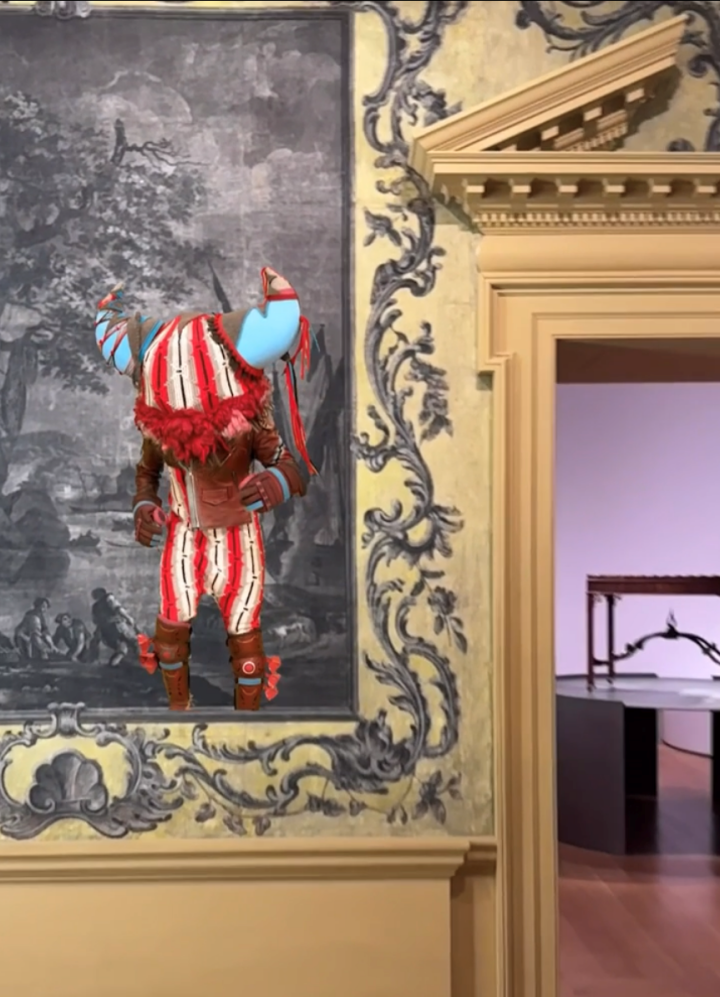
1. Encoded, unsanctioned virtual reality intervention at the Metropolitan Museum of Art, New York
On Indigenous Peoples’ Day 2025, Amplifier, a nonprofit design lab, launched ENCODED: Change the Story, Change the Future inside the Metropolitan Museum of Art’s American Wing. Seventeen Native artists used augmented reality to virtually overlay new Native artworks on the museum’s collection. Visitors activated the interventions via phones to reveal Indigenous dancers, cosmological beings, and pointed text integrated with the museum’s existing exhibits.
ENCODED featured Amelia Winger-Bearskin (Seneca-Cayuga), Bear Fox (Akwesasne Mohawk), Bird x Bird (an Indigenous-led design firm), Cannupa Hanska Luger (Mandan/Hidatsa/Arikara/Lakota), Cass Gardiner (Kebaowek Algonquin), Demian DinéYazhi (Diné), Jarrette Werk (Aaniiih/Nakoda), Jeremy Dennis (Shinnecock), Flechas and Josué Rivas (Mexica/Otomi), Katsitsionni Fox (Akwesasne Mohawk), Lite Brite Neon, Lokotah Sanborn (Penobscot), Mali Obomsawin (Odanak Abenaki), Mer Young (Mestiza), Nicholas Galanin (Tlingit/Unangax̂), Priscilla Dobler Dzul (Mestiza), and Skawennati (Kahnawà:ke Mohawk). Co-curated with Tracy Rector and an anonymous Indigenous collaborator, ENCODED framed the Indigenous overlays via AR not as a gimmick or protest but as a tactical tool that lets Native artists occupy a space the museum still treats as its canonical heart.
Download the Encoded zine.
2. Ralph T. Coe Rehoming Program
The Ralph T. Coe Center for the Arts spent 2025 undertaking one of the most thoughtful goodbyes the nonprofit arts world has seen. As the organization prepared to close its doors this December, it leaned fully into the ethos that shaped its founder’s vision: art belongs with the people and cultures who can speak to it. Rather than storing its Indigenous collections or dispersing them through impersonal market channels, the Coe Center amplified its Rehoming Program, a long-running effort to return works from its global collection of more than 2,500 Indigenous artworks to 48 (at time of publication) tribal museums, tribes, community institutions, and organizations committed to Indigenous leadership.
Each transfer has been deliberate, collaborative, and grounded in respect, guided by the Coe Center’s open Rehoming Request for Proposal (RFP). Introduced in April 2024 and extended through December, the RFP invited tribal nations, cultural organizations, community groups, and individual artists to request works that mattered to them. The Coe promoted the call widely, including at the Association of Tribal Archives, Libraries, and Museums conference. That process shaped every placement, pairing artworks with the people and places best positioned to steward their stories.
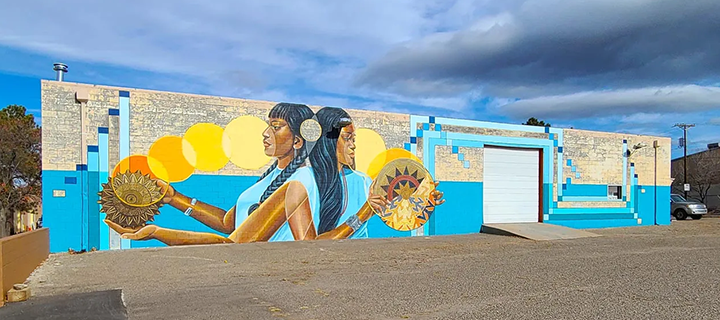
The centerpiece of this farewell is the Coe’s historic gift of its campus at 1590 Pacheco Street in Santa Fe to the Institute of American Indian Arts. The transfer includes the building itself, selected works for the IAIA Museum of Contemporary Native Arts, additional pieces for IAIA’s teaching collections, and funding to ensure the site is cared for well into the future. Other artworks are being welcomed into tribal museums such as the Osage Nation Museum and the Alutiiq Museum, while a dedicated auction of Western artworks helps to seed grants that support future rehoming efforts. In its final year, the Coe has transformed “closure” into a model of ethical succession, prioritizing Indigenous self-determination, cultural continuity, and long-term stewardship. It’s a rare example of a collection choosing rematriation over accumulation, and doing it with clarity, humility, and care.
3. Contemporary Anishinaabe Art: A Continuation at the Detroit Institute of Arts
Contemporary Anishinaabe Art: A Continuation is a landmark exhibition for the Detroit Institute of Arts and for Great Lakes Native art. On view from September 28, 2025, through April 5, 2026, this survey gathers more than 90 works by more than 60 Anishinaabe artists. Basketry, beadwork, birchbark, clothing, painting, sculpture, film, graphic design, and jewelry appear side by side, showing that Anishinaabe aesthetics continually evolve and respond to our current era.
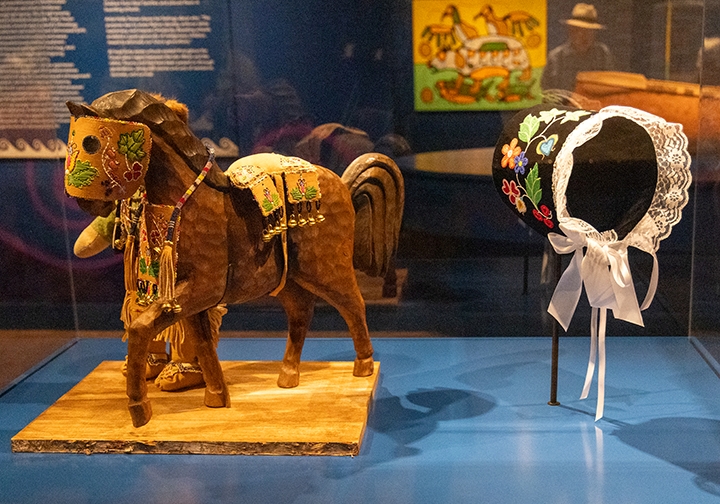
The DIA describes the show as one of the largest presentations of contemporary Native American art ever mounted in the Midwest and its first major Native American exhibition in 30 years. An advisory council of Ojibwe, Odawa, and Potawatomi artists helped shape its curatorial approach, which includes Anishinaabemowin-language labels and free admission to the exhibition for Indigenous visitors. The result is not just a survey of individual artists but a structural intervention in how a major museum positions Native art, language, and community within its broader collection.
Native visitors who show tribal IDs during the run of this exhibition (through April 5, 2026) will receive free admission to the DIA, thanks to support from the Rush Group of Companies. Children without a tribal ID will also be admitted free when accompanied by an adult with a valid tribal ID.
4. Grand opening of the Santa Ynez Chumash Museum and Cultural Center, CA
The opening of the Santa Ynez Chumash Museum and Cultural Center in Santa Ynez, CA on May 15, 2025, marks the culmination of a vision that has taken shape over half a century. The idea first surfaced in the 1970s, when a tule‘Ap (thatched round house) was constructed on the Santa Ynez Reservation as an early effort to share Chumash culture and material history. Momentum built steadily over the following decades. In 2000 the tribe began the process of placing a 6.9-acre parcel of land into federal trust for a future museum, a step that finally became reality in 2014. Soon after, the tribe commissioned Jones & Jones, led by distinguished architect Johnpaul Jones, whose work includes the Smithsonian National Museum of the American Indian, to imagine a museum rooted in Chumash place, identity, and stewardship.
The resulting cultural center is both a celebration of heritage and a forward-facing expression of Chumash values. Galleries explore language, medicine, music, daily life, and intergenerational knowledge, beginning with a Welcome Gallery that greets visitors with a blessing inviting open hearts and minds. The permanent exhibition unfolds across thousands of years of Chumash history, while classrooms and gathering spaces support hands-on learning and community events. Outdoors, gardens and an amphitheater reflect ecological knowledge and the long-standing emphasis on sustainability and balance within Chumash culture.
The building itself carries the same intentionality. Oriented toward the west in recognition of the Chumash as guardians of the Western Gate, the museum is also LEED Silver certified, underscoring the tribe’s commitment to environmental responsibility. High marks in water and energy efficiency, materials, and innovative design place the museum in a national conversation about sustainable Indigenous architecture. It is a place where ancestral wisdom meets contemporary design, and where the tribe can share its story on its own terms with visitors from around the world.
5. Tewa Nangeh/Tewa Country at the Georgia O’Keeffe Museum, Santa Fe
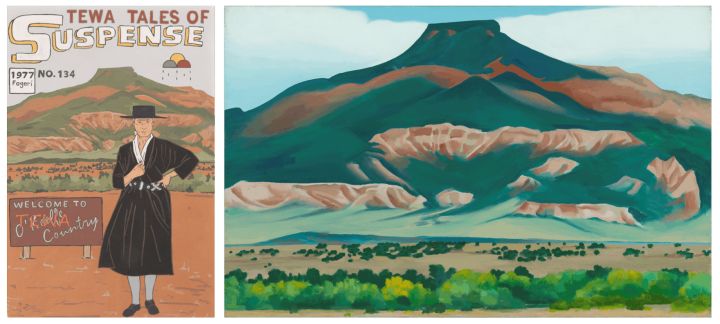
Tewa Nangeh/Tewa Country at the Georgia O’Keeffe Museum brings twelve Tewa artists into direct conversation with Georgia O’Keeffe’s paintings of Northern New Mexico, particularly the landscapes often branded as “O’Keeffe Country.” While O’Keeffe often framed Northern New Mexico as her own artistic terrain, the land itself has long belonged to six Tewa Pueblos, whose presence extends from time immemorial into the present day.
The exhibition opened on November 7, 2025, transforming galleries with Pueblo pottery, sculpture, painting, screen prints, drawing, video, and more. Rather than treating O’Keeffe’s work as a neutral modernist landscape, the show foregrounds Tewa understandings of place, kinship, and responsibility, making clear that these are ancestral homelands with ongoing Indigenous governance and cultural life.
Co-curated by Jason Garcia (Santa Clara Pueblo) and Bess Murphy, Tewa Nangeh will shift during its ten-month run, with selections reconfigured to reflect the living nature of Tewa culture. Participating artists include Joseph Woody Aguilar (San Ildefonso Pueblo), Samuel Villarreal Catanach (Pojoaque), Okuu Pín, Jason Garcia (Santa Clara Pueblo), John Garcia Sr. (Santa Clara Pueblo), Charine Pilar Gonzales (San Ildefonso Pueblo), Marita Swazo Hinds (Tesuque), Matthew Martinez (Ohkay Owingeh), Arlo Namingha (Ohkay Owingeh/Hopi), Michael Namingha (Ohkay Owingeh/Hopi), Eliza Naranjo Morse (Santa Clara Pueblo), Martha Romero (Nambé), and Randolph Silva (Santa Clara Pueblo).
The Santa Fe museum has made admission free for members of Indigenous communities for the duration of the exhibition and has tied the show to community events, family days, and public conversations about land, language, and representation.
6. Bancos Indígenas do Brasil: Rituais, Memorial dos Povos Indígenas, Palácio Itamaraty, and Museu Nacional da República, Brasília, Brazil
On display across three venues in Brasília: Memorial dos Povos Indígenas, Palácio Itamaraty, and Museu Nacional da República, Bancos Indígenas do Brasil: Rituais (Indigenous Benches of Brazil: Rituals) showcases the carved benches or thrones of 51 Indigenous groups, revealing the central importance of these carved items in Indigenous communities of Brazil.
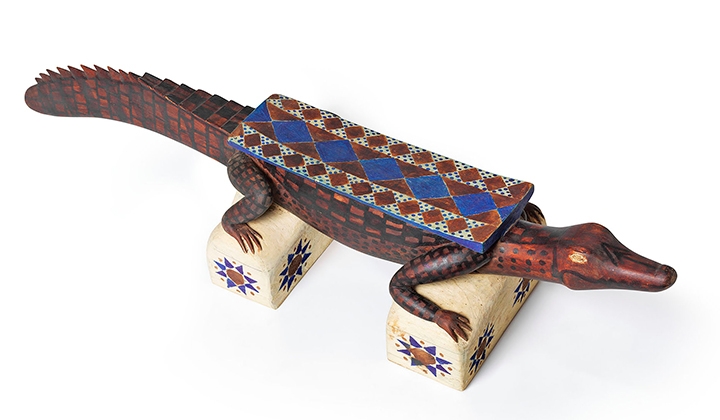
Drawing from the massive BEĨ collection acquired by Marisa Moreira Salles and Tomás Alvim, the stools represent Indigenous groups such as the Asurini, Fulni-ô, Guarani, Huni Kuin, Karajá, Mehinaku, Munduruku, Saterê Mawê, Tikuna, Waiwai, Wayana, Aparaí, Yudjá, Yawalapiti, Ye’kuana, and many others.
Akauã Kamayurá (Kamayurá), Yawapi Kamayurá (Kamayurá), Tawai Yudjá (Yudjá), Antônio Bane Huni Ku (Huni Kuin), Thiago Henrique Djekupe (Guaraní), Mayawari Mehinaku (Mehinaku), Rael Tapirapé (Tapirapé), Wareaiup Kaiabi (Kaiabi), Milton Galibi Nunes (Uaçá Galibi), Salomão Tikuna (Tikuna), Krumaré Karajá (Karajá), and Sokrowe Karajá (Karajá) assisted in selecting the pieces for Rituais in partnership with collectors Moreira Salles and Alvim and curator Danilo Garcia.
7. La mitad del mundo. La mujer en el México indígen, Madrid, Spain
La mitad del mundo. La mujer en el México indígena (Half the World: Women in Indigenous Mexico) is a major exhibition sponsored by the Casa de México Foundation in Spain, held in collaboration with the Mexican Government and the Instituto Nacional de Antropología e Historia, also of Mexico. Taking place across four institutions in the capital of Salamanca, including Casa de México, El Museo Nacional Thyssen-Bornemisza, El Instituto Cervantes, and the Museo Arqueológico Nacional, it’s billed as the most important exhibition of pre-Hispanic art ever organized in Spain and explores the fundamental role of women in Mexico’s Indigenous civilizations. Visitors will be able to view more than 400 pieces from 25 national collections.
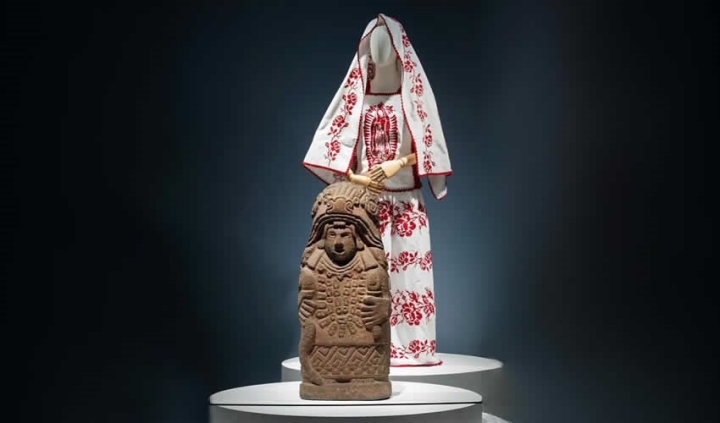
The exhibition is part of Mexico’s declaration of 2025 as the Year of Indigenous Women, a designation that recognizes their important role as keepers of memory, cultural customs, and ancestral knowledge. Mexica, Maya, Zapotec, Mixtec, Olmec, Huastec, and Teotihuacan cultures, among many others, are exhibited across the four institutions, and each institution features work within a general theme.
At El Instituto Cervantes, Woven Histories focuses on textile art as a means of expression, memory, and cultural transmission. Casa de México hosts The Divine Realm, bringing together sculptures, textiles, and ritual objects to explore the feminine principle in Indigenous worldviews. The Museo Arqueológico Nacional features “The Human Sphere,” exploring women’s central role in the daily lives of Indigenous communities, and El Museo Nacional Thyssen-Bornemisza presents “Lady Tz’AkaAb’Ajaw, the Red Queen of Palenque,” a section focused on the regalia of the 7th-century Maya ruler, highlighting the political and symbolic power of women throughout Mesoamerican history.
8. Sugarcane movie (2024) nominated for an Academy Award
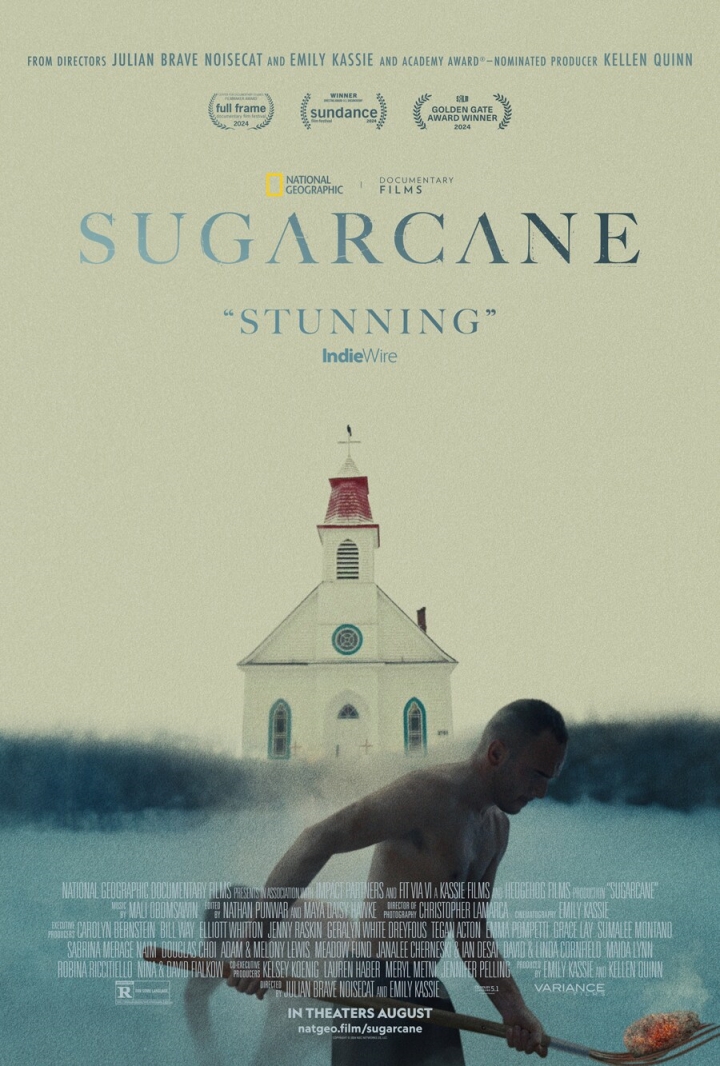
In 2025, Sugarcane, a National Geographic documentary film by Julian Brave NoiseCat (Canam Lake Secwepemc) and Emily Kassie, became the first film directed by a First Nations filmmaker to be nominated for an Oscar. Nominated in the Documentary Feature category for the 97th Academy Awards, Sugarcane is a moving, highly personal, and important investigation into the horrific abuse and crimes committed at an Indian residential school. The film premiered at the Sundance Film Festival on January 20, 2024, where it won the Grand Jury award for Directing.
The synopsis from National Geographic reads: “In 2021, evidence of unmarked graves was discovered on the grounds of an Indian residential school run by the Catholic Church in Canada. After years of silence, the forced separation, assimilation, and abuse many children experienced at these segregated boarding schools was brought to light, sparking a national outcry against a system designed to destroy Indigenous communities.
Set amid a groundbreaking investigation, Sugarcane illuminates the beauty of a community breaking cycles of intergenerational trauma and finding the strength to persevere.”
9. James Lavadour: Land of Origin at the Jordan Schnitzer Museum of Art, Eugene, OR
Spanning five decades of work, James Lavadour: Land of Origin presents the most comprehensive survey to date of works by painter and printmaker James Lavadour (Walla Walla). Curated by Danielle Knapp, the exhibition showcases Lavadour’s deep connection to the landscapes of his home, the Umatilla Indian Reservation in Eastern Oregon, and also celebrates his place as one of the most important contemporary painters in the U.S. Nearly 30 of Lavadour’s signature multi-grid paintings are featured.
A full-time artist since the 1980s, Lavadour is self-taught, achieving his first museum exhibition in 1990. Since then, he has been awarded multiple commissions and awards and included in notable international exhibitions such as Personal Structures during the 55th Venice Biennale.
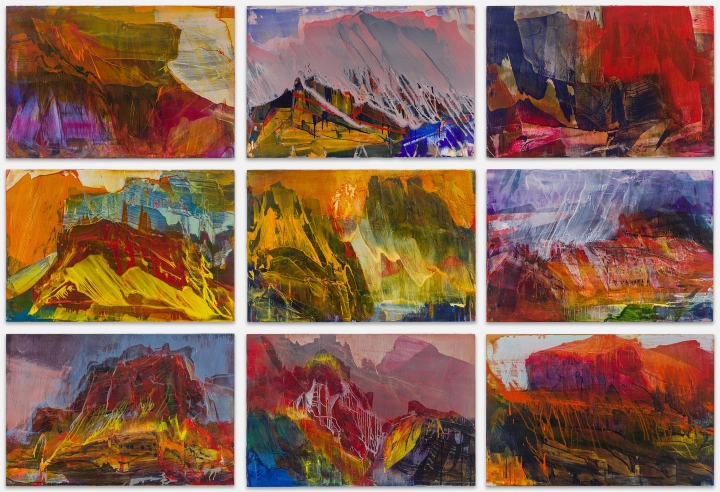
76 x 112 x 2 in. Photo courtesy UO Jordan Schnitzer Museum of Art and Art Bridges.
A full catalogue accompanies James Lavadour: Land of Origin which is on view until January 11, 2026, at the Jordan Schnitzer Museum of Art on the University of Oregon campus in Eugene, Oregon. After that time, it will travel to additional museums, thanks to a collaboration with the Art Bridges Foundation.
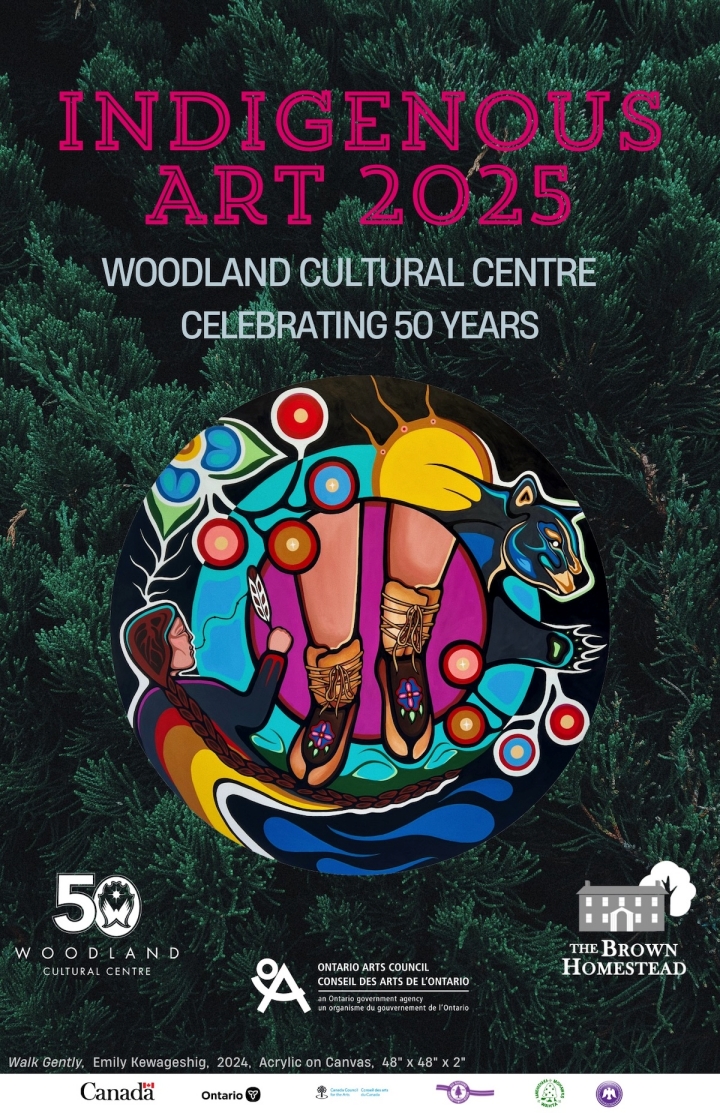
10. Indigenous Art 2025: 50th Annual Juried Exhibition at the Woodland Cultural Centre, Brandford, ON
The 50th Annual Indigenous Art Juried Exhibition at the Woodland Cultural Centre in Brantford, Ontario, represented a significant milestone. It celebrated five decades of a “platform for Indigenous artists to present their work in a gallery setting, challenge colonial narratives, engage in visual experimentation, and affirm their sense of self.” Jurors Jody Martin (Grand River Mohawk), Mikinaak Migwans (Wiikwemikoong Anishinaabe), and Brenda Mitten (Grand River Seneca) undertook the daunting task of reviewing over 200 submissions, narrowing them down to 65 selected works. Alex Jacobs-Blum (Cayuga) served as the guest curator.
In addition to the juried exhibition, Tending to the Seeds, a two-person show that honored the artistic practices of Patricia Deadman (Grand River Tuscarora/Mohawk, 1961–2024) and Thomas V. Hill (Grand River Seneca, 1943–2023) took place.
The Woodland Cultural Centre was established in October 1972 under the direction of the Association of Iroquois and Allied Indians upon the closure of the Mohawk Institute Residential School. This year, the center opened the residential school as a museum and memorial.
Prior Top Ten Native Art Events
2024 | 2023 | 2020 | 2019 | 2018 | 2017 | 2016 | 2015 | 2014
2 Comments
I am very happy to be featured in the article talking about indigenous benches. I am a painter, poet, and composer. I live in Manaus, in the Amazon rainforest. I am passionate about indigenous art. Visit my Instagram @ruimachadoam and my website to learn more about my art.
Thank you very much.
Fantastic! Keep up all the good work and happy 2026 to you!